


 Cart
Cart
 sales@molnova.com



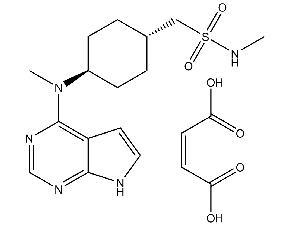
Oclacitinib maleate
CAS No. 1640292-55-2
Oclacitinib maleate( PF-03394197 maleate )
Catalog No. M17356 CAS No. 1640292-55-2
Oclacitinib is a novel inhibitor of JAK family members with IC50 ranging from 10 to 99 nM and JAK1-dependent cytokines with IC50 ranging from 36 to 249 nM, which did not inhibit a panel of 38 non-JAK kinases.
Purity : >98% (HPLC)
 COA
Datasheet
HNMR
HPLC
MSDS
Handing Instructions
COA
Datasheet
HNMR
HPLC
MSDS
Handing Instructions
| Size | Price / USD | Stock | Quantity |
| 2MG | 41 | Get Quote |


|
| 5MG | 65 | Get Quote |
|
| 10MG | 91 | Get Quote |
|
| 25MG | 160 | Get Quote |
|
| 50MG | 257 | Get Quote |
|
| 100MG | 432 | Get Quote |
|
| 200MG | Get Quote | Get Quote |
|
| 500MG | Get Quote | Get Quote |
|
| 1G | Get Quote | Get Quote |
|
Biological Information
-
Product NameOclacitinib maleate
-
NoteResearch use only, not for human use.
-
Brief DescriptionOclacitinib is a novel inhibitor of JAK family members with IC50 ranging from 10 to 99 nM and JAK1-dependent cytokines with IC50 ranging from 36 to 249 nM, which did not inhibit a panel of 38 non-JAK kinases.
-
DescriptionOclacitinib is a novel inhibitor of JAK family members with IC50 ranging from 10 to 99 nM and JAK1-dependent cytokines with IC50 ranging from 36 to 249 nM, which did not inhibit a panel of 38 non-JAK kinases.(In Vitro):Using isolated enzyme systems and in vitro human or canine cell models, potency and selectivity of Oclacitinib is determined against JAK family members and cytokines that trigger JAK activation in cells. Inhibitory activity of Oclacitinib against JAK family members is determined in isolated enzyme systems. Oclacitinib inhibits JAK1, JAK2, JAK3, and TYK2 by 50% at concentrations (IC50's) of 10, 18, 99, and 84 nM, respectively. Oclacitinib is most potent against the JAK1 enzyme, showing a 1.8-fold selectivity for JAK1 vs. JAK2 and 9.9-fold selectivity toward JAK1 vs. JAK3. Oclacitinib inhibits JAK family members by 50% at concentrations (IC50's) ranging from 10 to 99 nM and does not inhibit a panel of 38 non-JAK kinases (IC50's >1000 nM). Oclacitinib also inhibits the function of JAK1-dependent cytokines involved in allergy and inflammation (IL-2, IL-4, IL-6, and IL-13) as well as pruritus (IL-31) at IC50's ranging from 36 to 249 nM. Oclacitinib has minimal effects on cytokines that does not activate the JAK1 enzyme in cells (erythropoietin, granulocyte/macrophage colony-stimulating factor, IL-12, IL-23; IC50's >1000 nM).Topical treatment with Tofacitinib (0.1%) and Oclacitinib (0.1%) leads to significant reduction of cell migration from mouse ear explants compared with vehicle-treated ears (all P < 0.05). The cell counts of MHC class II positive cells (that is, Langerhans cells) are significantly lower in vehicle-treated compared with each JAK inhibitor–treated epidermis (all P<0.01). (In Vivo):Scratching bouts at the high dose in the Oclacitinib group are significantly less than in the vehicle-only group (P<0.01). Client-owned dogs (n=436) with moderate to severe owner-assessed pruritus and a presumptive diagnosis of allergic dermatitis are enrolled. Dogs are randomized to either Oclacitinib at 0.4-0.6 mg/kg orally twice daily or an excipient-matched placebo. An enhanced 10 cm visual analog scale (VAS) is used to assess the severity of pruritus from day 0 to 7 and to assess the severity of dermatitis on days 0 and 7. Dogs can remain on the study for 28 days. Oclacitinib produces a rapid onset of efficacy within 24 h.
-
In VitroUsing isolated enzyme systems and in vitro human or canine cell models, potency and selectivity of Oclacitinib is determined against JAK family members and cytokines that trigger JAK activation in cells. Inhibitory activity of Oclacitinib against JAK family members is determined in isolated enzyme systems. Oclacitinib inhibits JAK1, JAK2, JAK3, and TYK2 by 50% at concentrations (IC50's) of 10, 18, 99, and 84 nM, respectively. Oclacitinib is most potent against the JAK1 enzyme, showing a 1.8-fold selectivity for JAK1 vs. JAK2 and 9.9-fold selectivity toward JAK1 vs. JAK3. Oclacitinib inhibits JAK family members by 50% at concentrations (IC50's) ranging from 10 to 99 nM and does not inhibit a panel of 38 non-JAK kinases (IC50's >1000 nM). Oclacitinib also inhibits the function of JAK1-dependent cytokines involved in allergy and inflammation (IL-2, IL-4, IL-6, and IL-13) as well as pruritus (IL-31) at IC50's ranging from 36 to 249 nM. Oclacitinib has minimal effects on cytokines that does not activate the JAK1 enzyme in cells (erythropoietin, granulocyte/macrophage colony-stimulating factor, IL-12, IL-23; IC50's >1000 nM).Topical treatment with Tofacitinib (0.1%) and Oclacitinib (0.1%) leads to significant reduction of cell migration from mouse ear explants compared with vehicle-treated ears (all P < 0.05). The cell counts of MHC class II positive cells (that is, Langerhans cells) are significantly lower in vehicle-treated compared with each JAK inhibitor–treated epidermis (all P<0.01).
-
In VivoScratching bouts at the high dose in the Oclacitinib group are significantly less than in the vehicle-only group (P<0.01). Client-owned dogs (n=436) with moderate to severe owner-assessed pruritus and a presumptive diagnosis of allergic dermatitis are enrolled. Dogs are randomized to either Oclacitinib at 0.4-0.6 mg/kg orally twice daily or an excipient-matched placebo. An enhanced 10 cm visual analog scale (VAS) is used to assess the severity of pruritus from day 0 to 7 and to assess the severity of dermatitis on days 0 and 7. Dogs can remain on the study for 28 days. Oclacitinib produces a rapid onset of efficacy within 24 h.
-
SynonymsPF-03394197 maleate
-
PathwayCell Cycle/DNA Damage
-
TargetAurora Kinase
-
RecptorJAK1 |JAK2|TYK2 |JAK3
-
Research AreaInflammation/Immunology
-
Indication——
Chemical Information
-
CAS Number1640292-55-2
-
Formula Weight453.51
-
Molecular FormulaC15H23N5O2S·C4H4O4
-
Purity>98% (HPLC)
-
SolubilityDMSO : ≥ 100 mg/mL; 220.50 mM
-
SMILESOC(=O)\C=C/C(O)=O.CNS(=O)(=O)C[C@H]1CC[C@@H](CC1)N(C)C1=C2C=CNC2=NC=N1
-
Chemical Name——
Shipping & Storage Information
-
Storage(-20℃)
-
ShippingWith Ice Pack
-
Stability≥ 2 years
Reference
molnova catalog



related products
-
Aurora Kinase Inhibi...
Aurora kinase inhibitor III is a potent inhibitor of Aurora A kinase (IC50?= 42 nM).1?It is selective for Aurora A over BMX BTK IGF-1R c-Src TRKB SYK and EGFR.
-
BPR1K653
BPR1K653 is a novel potent Aurora kinase inhibitor that inhibits Aurora-A and Aurora-B with IC50 of 24 nM and 45 nM, respectively.
-
NU6140
NU6140 is a selective inhibitor of CDK2-cyclin A (IC50, 0.41 μM).
